Blue skies and seasonally warm temperatures met Jeremy Johansen as he headed for the Palmer Moose Range on August 22nd to set up his hunting camp. “Normally I just take off and don’t tell anyone where I’m going. But this day my mom asked so I told her.”
Just an hour’s ride up into the wilderness, he staked out a secluded spot on the edge of a small lake overlooking the lake, marshes and mountain ranges in the distance.
“It’s a really great place where I can glass the hillsides looking for moose,” he explained.
This day he had the place all to himself. “The state fair was in full swing and everyone else was there. It was the perfect time to get my hunting camp set up before the season opener on August 25th.”
After snapping a quick photo, he headed downhill toward home; a familiar route he’d driven more than a 100 times. Traveling about five miles an hour, he was startled when a boulder rolled down the side of the bank above him and on to the trail.
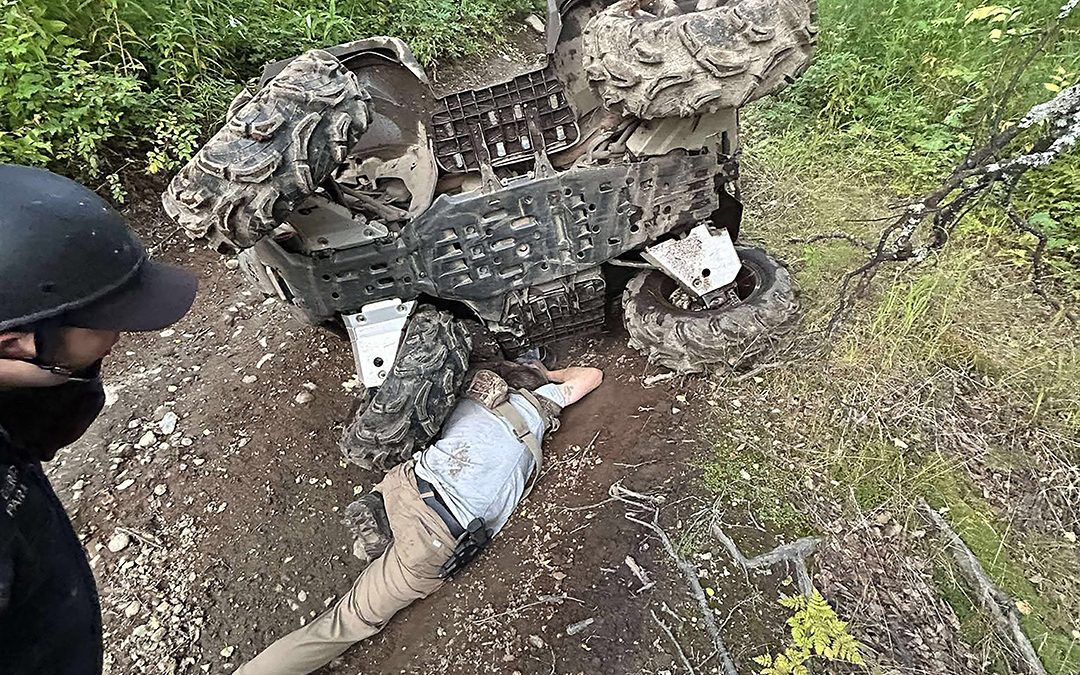
“This boulder caught me off guard. I hit it with the knobby part of my front tire but I was able to steer out of it. But a second later I hit it with my back tire and it just bucked up and booted me right off the wheeler.”
Twisting in the air, he saw 900 pounds of metal headed right for him.
“I tried to tuck and roll out of the way but only made it part way when the machine body slammed me to the ground.”
Pinned in place, Johansen knew he was in serious trouble. He thought his legs were straight behind him but couldn’t feel or move anything. At first, even the slightest twitch happened only in his mind.
“I couldn’t even wiggle my little finger.”
The realization that he was alone spurred him on. “I knew I had to try if I was going to survive.”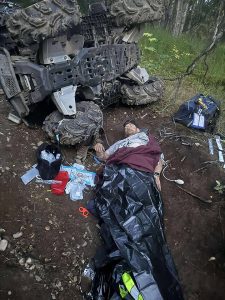
His Apple watch had detected his crash and was asking for him to confirm. Struggling to lift his hand, he felt something move in his neck. “I knew I shouldn’t move. But I also knew I didn’t have any other choice.” He felt the machine shift and froze, terrified it would slide further onto him.
He stayed still for what seemed a long time, contemplating what to do next. “I was getting chilled and knew, I needed help. I finally managed to get my watch up to my face and touched the screen with my tongue.”
Instead of alerting authorities of his crash, he inadvertently hit the dismiss button.
“By this point, I figured I was going to die,” he said.
His final hope was Siri. “Siri call help,” his said, his voice soft and weak. The watch remained silent. He tried again. The watch didn’t understand. “It took three tries before my voice was strong enough and I said Siri, call 911.”
Relief flooded through him when he was suddenly connected to the Alaska State Trooper emergency dispatch.
“I’ve crashed and need help,” he told them. While he waited, he learned that they dispatched the State Trooper from the far side of Wasilla which would take at least two hours for them to reach him. “They asked if there was anyone else they could contact so I told them to call my Mom. She didn’t answer. That’s when I knew, I had to hang on and live no matter the consequences or shape I’d be in.”
From this point on, all he could do was wait. “I lay there thinking about my mom and how she’d already lost my little brother when he was nine, and then my dad. I just couldn’t die and hurt her again.”
For the next two hours, Johansen counted, recited the alphabet and did math problems from memory like he had learned from his father when he was a kid. He thought about friends and family, tried shouting because he thought he’d heard something moving in the woods, and forced himself to stay conscious and strong for his mother.
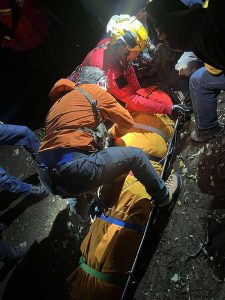 He felt his resolve beginning to weaken when the sound of a wheeler reached him and an Alaska State Trooper and EMT rolled up to find him.
Minutes later Johansen was surprised to see his friend Jordan Spera ride up. “I asked, what are you doing here dude?”
“I came to find you,” Spera told him. “And I brought more help.”
Turns out, his mother contacted his friend who served as a guide to point the way. “There are so many trails and places to go in that area,” he said, “unless you really know where to look, it’s tough to find anyone out there.”
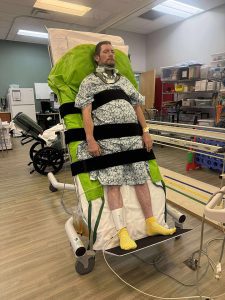
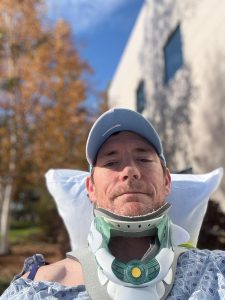
The EMT began treating him for shock and hypothermia, secured his neck with a c-spine collar, and contacted a life-flight helicopter. They were involved in another rescue so the National Guard sent a Jayhawk Helicopter para jumper crew who successfully transported him to emergency care. After a lengthy surgery to piece his spine back together, he’s now on the road to healing.
“I know I’m really lucky to be alive. And I know it’s going to be a long, hard battle,” he admits, “but I’m determined to walk again.”
His advice to others; “When I ride snowmachines I usually wear a helmet and tech vest, but when I’m hunting I usually don’t. I wasn’t that day. I didn’t end up with any head injuries, but I easily could have. I understand, this could have turned out a lot worse, so I’d definitely recommend wearing safety protection. And even more important, tell someone where you’re going and when you think you’ll be back. I am guilty of not doing that. This day, for some reason my mom asked so I’d told her. That really helped the troopers and my friend get them right to me in time to save my life.”
The biggest lesson after all of this for Jermey? “Don’t take anything for granted. You might have done this same trip 100 times, but one loose rock and you could find yourself in a whole new world. Everything can change in an instant. Instead of climbing mountains and harvesting moose, you could end up needing help just to sit up.”
You can follow Jeremy’s healing Journey at https://www.facebook.com/jeremy.johansen.9
Wow, thank you so much for sharing your story. Recently, my husband and I were driving and saw a dad and his young daughter — maybe 7 or 8 — riding together at a pretty fast speed down a straight stretch. Much like in your story, it reminded me how quickly one small mistake, turn, or loose rock can change everything in an instant.
I’m not an outdoor enthusiast or an experienced rider myself, but I truly enjoyed reading your blog. The world is a better place with you in it, and I believe you’d make a wonderful speaker to share your story and recovery journey with students around the district once you’ve reached your goal and made it home. Wishing you continued strength and healing — God bless!
Thank you very much, Tiffany, I have no problem sharing my story and anybody can follow along on my Facebook page. I’m posting daily of my recovery efforts not trying to hide anything. I want people to see the difficulty and help inspire me as well as me inspiring others. I look forward to doing Some speaking in the Alaska safe riders safety classes, which I have been invited to. And yeah, my story is like so many others and there have been some very unlucky people. I’m just extremely thankful that I wore my Apple Watch that day because it truly saved my life. I can’t thank Debra Mcghan enough for helping spread my story! I truly appreciate your words and your thoughts. Thank you again.
That is a heck of a blow, Jeremy. I’m happy to hear that you are getting some return. You never know how much you could get back, but it could take a few years before everything settles down. I wish you all the luck in the world for the best recovery possible! Hang in there, man, and hit me up anytime if you need to talk. I will check in with you from time to time to see how things are going. God’s speed to you!