Hidden beneath the snow….
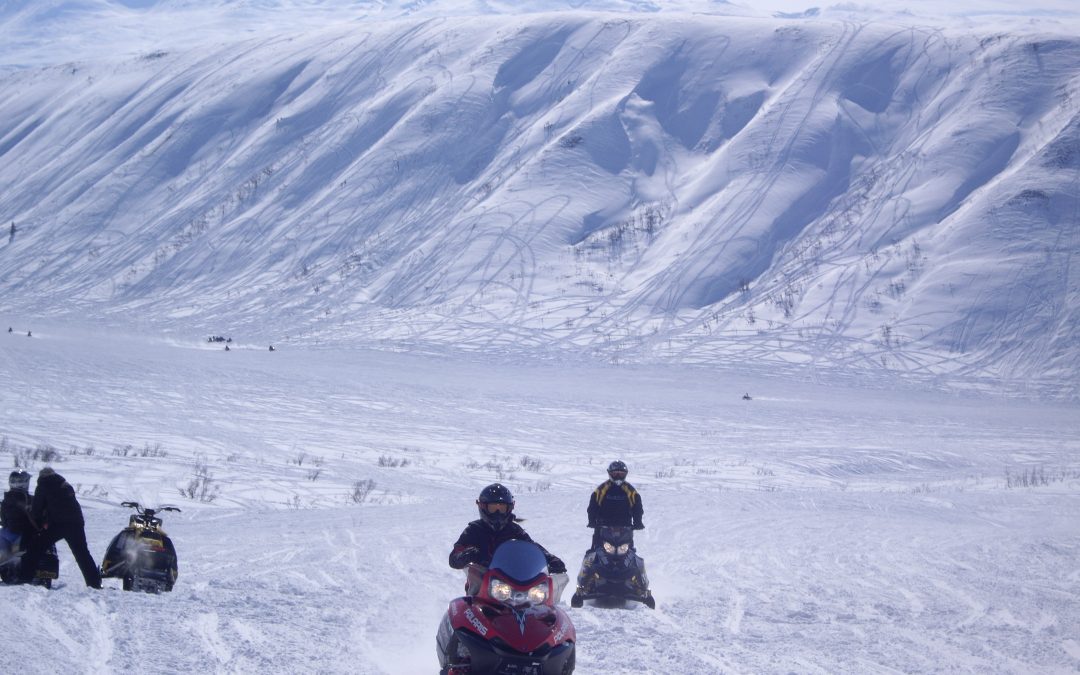
On a snowy April morning in Alaska’s Hoo Doo Mountains near Paxson, thousands of snowmachine engines shattered the silence in a rolling roar. The sound spread across the valley like thunder, echoing off ridgelines and glaciers as riders carved across a vast white landscape.
Each spring this remote stretch of Alaska backcountry transforms into the site of Arctic Man—one of the wildest winter gatherings in North America. The event pairs an intense downhill ski race with high-speed snowmachine competition, drawing thousands of riders and spectators eager for adrenaline and deep powder.
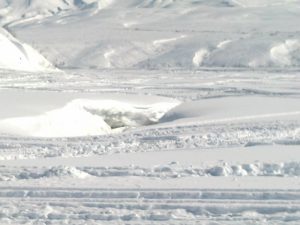
It’s important to stay alert and aware of your surroundings. Dangers can hide in plain site.
But beyond the roar of engines and celebration of speed, the landscape holds quieter dangers. Beneath those endless snowfields lie hidden crevasses, avalanche paths, and glacier drains capable of swallowing a machine—or a person—in seconds.
I attended Arctic Man for years not to race, but to raise awareness about those hazards. With support from the Alaska Department of Public Safety, organizations like the North America Outdoor Institute, the Alaska Avalanche Information Center, and Alaska Safe Riders bring safety education directly to riders gathered in the mountains.
The budget is small, so our team stretches every dollar and leans heavily on volunteers.
In April 2013 we arrived in the middle of a snowstorm. Visibility dropped to near zero, and if the weather failed to clear, the race itself might be postponed. By Thursday the storm began to break. Our team headed into the field to scout locations for what we called our “safety game”—an interactive training activity designed to help riders recognize hidden backcountry hazards.
That evening we hosted a poker-style fundraiser in the big tent, selling tickets for a chance to win a brand-new Ski-Doo snowmachine donated by BRP. The event gave us an opportunity to talk with riders about avalanche awareness and glacier travel while raising funds to support our safety programs in schools across Alaska.
By Saturday morning the skies cleared. The race wrapped up, the crowd celebrated, and our small team had already connected with more than 2,000 people through the training game. Flyers, banners, and safety reminders reached thousands more. By the end of the weekend, we had raised over $10,000 to keep our outreach programs moving forward.
For the first time in days, we also had a few quiet hours.
I strapped on my skis and headed out alone for a peaceful Nordic tour—part exercise, part stress relief, part celebration of what our small team had accomplished.
Beyond the energy of the Arctic Man camp, the valley opened into a wide snowfield stretching toward the toe of a glacier. As I skied across the open terrain, I noticed a shallow depression in the snow.
Experience told me immediately what it was: a potential hazard. Glaciers have vertical shafts where meltwater drains deep into the ice below. Some of these openings plunge hundreds of feet beneath the surface. I stopped and took a few photos, thinking they would make powerful teaching images for future training sessions.
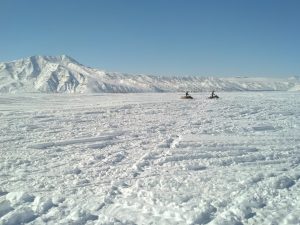
Thousands of riders show up at Arctic Man in April to experience the Hoo Doo Mountains and the adrenalin fueled excitement.
Around me, snowmachines zipped across the same field. Riders accelerated across the terrain and I realized how easily someone could approach the depression from the wrong angle and miss it entirely until the last second.
In the distance I spotted another lone skier gliding toward the foothills of the glacier. We raised our ski poles in greeting as we passed far across the valley.
Not long after, I turned back toward camp. We still needed to prepare for our final activities before the awards ceremony that evening.
In an instant, everything changed.
Instead of celebration, Alaska State Troopers approached me with a request. A young boy had fallen into a glacier moulin.
The lone skier I had seen earlier—an emergency room doctor—had reached the scene first but lacked the technical equipment needed to descend safely into the glacier.
Our training team carried ropes and rescue gear, so I sent one of our professional instructors and Wilderness EMT, to assist.
Several hours later he returned with news no one wanted to hear.
Nine-year-old Shjon Brown had fallen into the moulin along with his snowmachine. Deep beneath the snow and ice, rescuers could not reach him in time.
Shjon’s death was not the result of recklessness. Like many tragedies in Alaska’s backcountry, it came from a hidden hazard and a moment of terrible misfortune.
“Shjon was my right-hand man,” his father Roger later said. “We did everything together. He cheered me on when I raced. In fact, he convinced me to enter both Arctic Man and the Iron Dog.”
Earlier that day the group had been riding and towing friends on snowboards.
“We were waiting for the skiers and riders to come down,” Roger explained. “Shjon wanted to ride around a little. He’d been riding for years, so I just told him to stay where I could see him.”
Roger watched his son riding about a hundred yards away.
“He dropped into a small depression but didn’t come back out. I thought the machine had gotten stuck.” When Roger rode over to help, he discovered something far worse.
The glacier had swallowed both the snowmachine and his son.
Losses like this ripple through families and communities for years. They also remind us why education matters.
Organizations like the Alaska Avalanche Information Center and Alaska Safe Riders continue working to provide free safety training at events like Arctic Man so riders can recognize the hidden hazards that lie beneath Alaska’s snow. Roger Brown now volunteers as a safety instructor for Alaska Safe Riders.
He knows that from a distance, the valley still looks the same—a wide open, beautiful snowfield stretching toward the mountains, dotted with riders carving across fresh powder.
He also knows that sometimes the most dangerous places in Alaska look exactly like the safest ones.
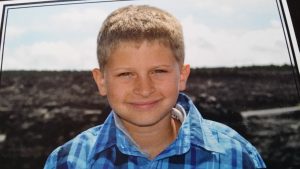
Shjon Brown, fell into a glacier moulin at Arctic Man, April 2013. He was 9-years old.
Story and Arctic Man photos by Debra McGhan. Shjon’s photo courtesy Roger Brown
In memory of Shjon Brown, please take the time to get educated and stay aware when riding in Alaska!